Meter Loading in CP Potential Measurements
Quick answer
A voltmeter can change the voltage it is trying to measure when its input resistance is not high enough relative to the effective resistance of the measurement circuit. This is meter loading.
A “high-impedance” meter reduces the problem, but no single input-resistance value is universally sufficient for every CP measurement.
Why it happens
A field potential-measurement circuit is not an ideal voltage source. It can include resistance from the reference electrode and its electrolyte contact, soil/electrolyte paths, leads and connections, and other effective source/circuit elements.
A real voltmeter has finite input resistance. When the meter is connected, it draws a small current. If the circuit resistance is significant compared with the meter input resistance, that current causes the meter-terminal voltage to differ from the circuit’s open-circuit source voltage.
Is 10 MΩ enough?
10 MΩ is a common field-meter value and is adequate in many ordinary conditions. It is not a universal sufficiency threshold.
Dry, rocky, sandy, frozen, oily, or otherwise high-resistance conditions can require much higher input resistance. Poor reference-electrode contact can also increase the effective circuit resistance.
The relevant question is whether the meter input resistance is sufficiently high relative to this measurement circuit for the required accuracy.
Signs that meter loading may matter
- The potential changes when a different meter is used.
- The reading changes when selectable input resistance is changed.
- The reference electrode is on dry, rocky, frozen, sandy, or difficult contact.
- Circuit resistance is unusually high.
- A reading has unexpectedly low magnitude and other causes have been checked.
These are diagnostic clues, not proof by themselves.
Equivalent-circuit model
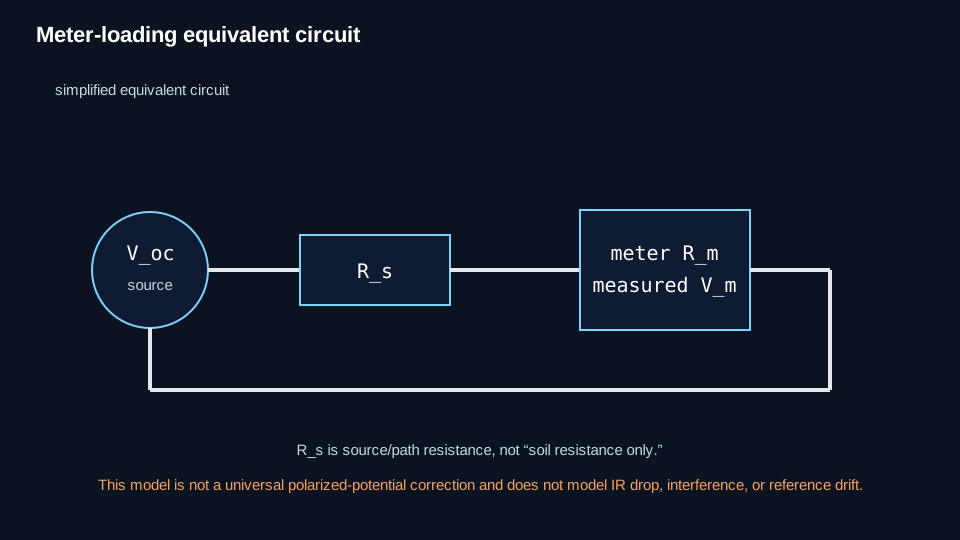
A simplified technical model represents the measurement as open-circuit source voltage V_oc, effective source/circuit resistance R_s, and meter input resistance R_m.
V_m = V_oc × R_m / (R_s + R_m)
This model is useful for understanding loading. It is not a universal CP “true potential” equation. Solving for open-circuit voltage is valid only when the simplified model is appropriate, the resistances are validly known for the same condition, the circuit is sufficiently stable and linear, and the error being corrected is specifically meter loading.
What a higher-input-resistance meter fixes—and does not fix
Higher input resistance reduces instrument loading.
It does not correct reference-electrode drift or contamination, electrolyte IR drop, metallic voltage drop, poor placement, incomplete current interruption, interference, or mixed potentials.
Field checks
- Verify reference-electrode condition and contact.
- Determine circuit resistance where practical.
- Compare readings at different meter input resistances where the instrument or method allows.
- Determine whether the measured potential becomes stable above a sufficiently high input resistance.
- Keep unrelated error mechanisms separate.
About “true potential correction”
Do not use a meter-loading calculation to claim that the result is the electrochemical polarized potential at the structure/electrolyte interface.
The calculation can estimate the open-circuit voltage of the simplified measurement circuit when its assumptions are satisfied. It corrects a loading model, not every field measurement error.
What to check next
If the reading changes with reference-electrode location, use Reference-Electrode Placement and IR Drop.
If the issue is the overall meaning of the measured voltage, use Structure-to-Electrolyte Potential.
The separate meter-loading Calculation remains nonpublic until its conditional assumptions are inseparable from the implementation.
Technical visuals