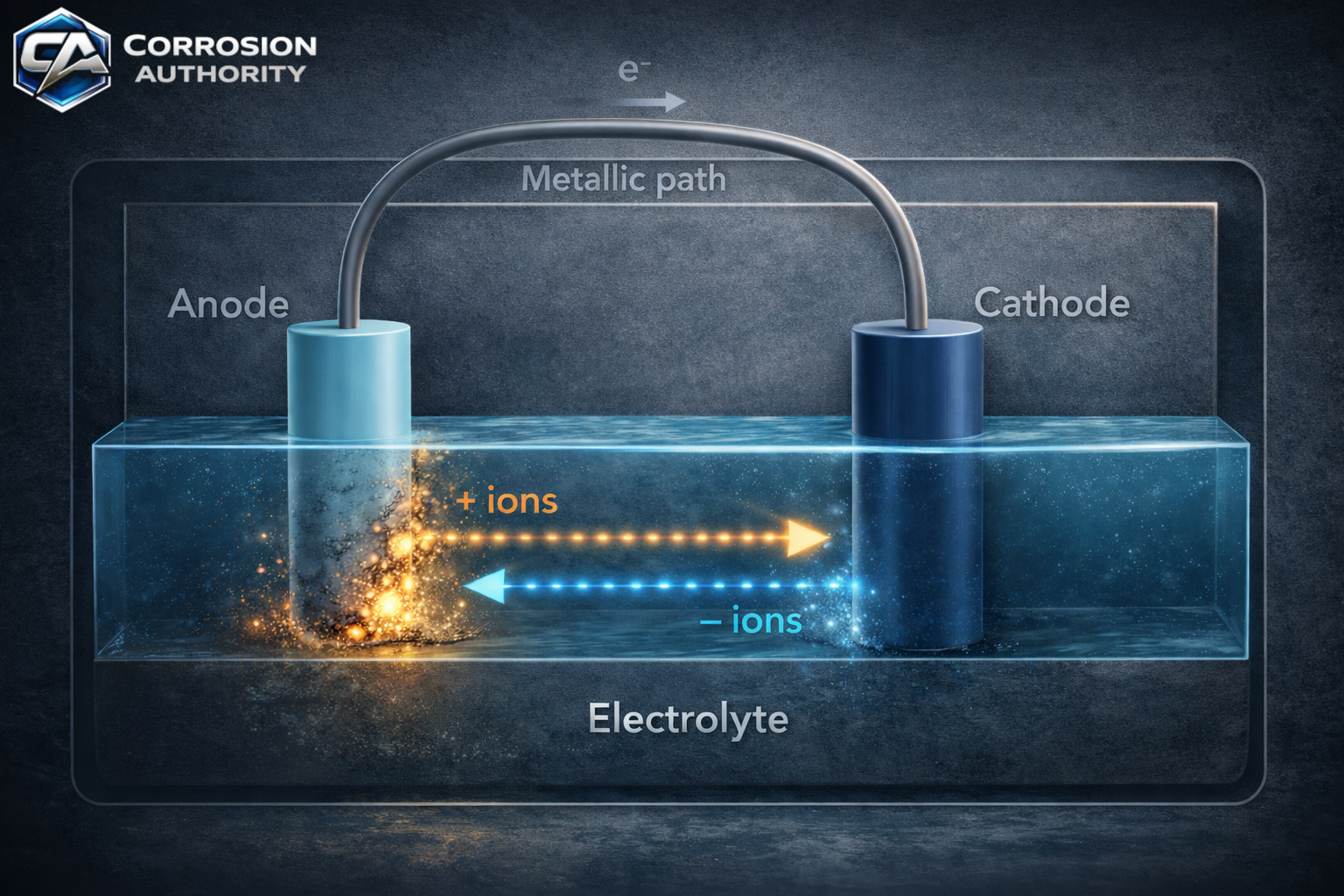
Corrosion Circuit Simulator
A corrosion cell requires four components: an anode, a cathode, a metallic path that electrically connects the anode and cathode through the metal, and an electrolyte that provides an ionic path between the anode and cathode. These four elements form a complete electrochemical circuit. Corrosion can therefore be understood as a naturally occurring electrical circuit in which current flows through both the metal and the surrounding electrolyte.
This animation simulates the electrochemical circuit involved in corrosion. At the anode, metal atoms undergo oxidation, releasing electrons into the metallic path while the metal atoms enter the electrolyte as metal ions. The electrons travel through the metal to the cathode, where reduction reactions occur. In the animation, the moving gray particles represent electrons traveling through the metal.
At the same time, ionic current flows through the electrolyte to maintain electrical charge balance between the anodic and cathodic reactions. The positive ions (+) shown in the animation represent metal atoms that have left the anodic surface and entered the electrolyte as dissolved metal species. The negative ions (−), shown as blue particles, represent ions already present in the electrolyte—such as chloride, hydroxide, or sulfate—that move through the solution to maintain electrical neutrality in the electrolyte as the electrochemical reactions proceed.
Both electron flow in the metal and ion flow in the electrolyte are required to complete the electrochemical circuit. If any one part of the circuit—the anode, cathode, metallic path, or electrolyte—is interrupted, the electrical circuit is broken and corrosion current stops.
Corrosion is an electrochemical circuit in which electrons flow through metal while ions flow through the electrolyte to complete the circuit.
Cathodic protection works by supplying electrical current from external anodes through the electrolyte to the structure. This current enters the metal surface and forces the structure to behave as a cathode instead of an anode. By providing electrons to the metal surface, cathodic protection prevents the oxidation reaction that causes metal loss. In other words, cathodic protection modifies the electrochemical circuit so that the protected structure no longer acts as the anodic location where corrosion occurs.