Interactive Simple Electrical Circuit Simulator
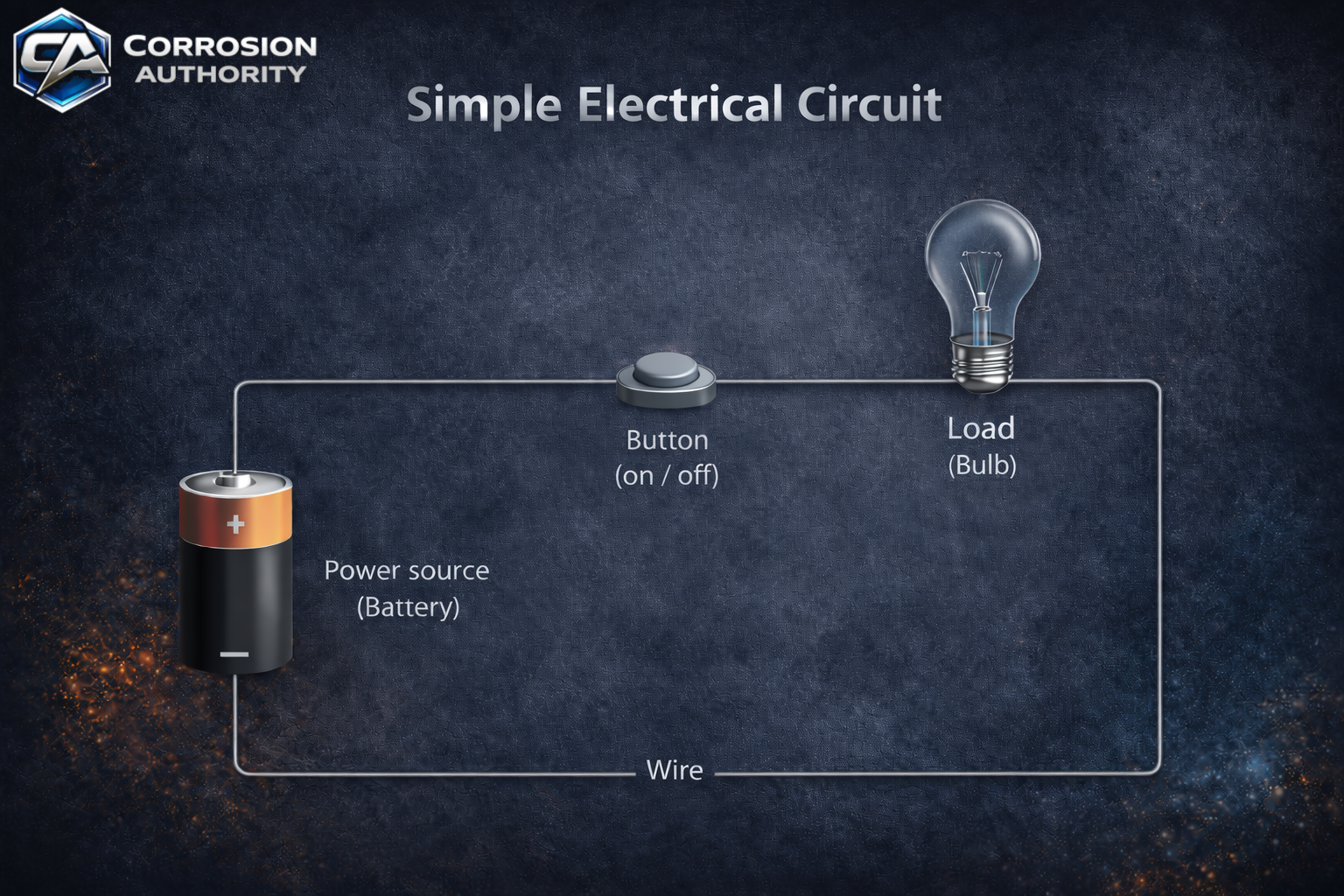
Click the button in the diagram to close or open the circuit. When the circuit is closed, electrons move through the wire and the bulb illuminates.
A simple electrical circuit requires three basic components: a power source, a conductive path, and a load. In this simulation the power source is a direct-current (DC) battery. The battery provides electrical energy, the conductive path allows electrons to move through the circuit, and the load uses that electrical energy to perform work. These components must form a complete closed circuit for current to flow.
This animation simulates how electrical current moves through a simple circuit powered by a DC battery. The battery creates a difference in electrical potential between its terminals that drives the movement of electrons through the conductive path. In the simulation, electrons leave the negative terminal of the battery, travel through the circuit wiring and the load, and eventually return to the positive terminal, completing the electrical loop. The moving particles in the animation represent electrons traveling through the conductor.
When the circuit is complete, electrons move continuously through the conductive path and the load can use the electrical energy provided by the battery. In practical circuits, the load may be a device such as a light bulb, resistor, motor, or electronic component that converts electrical energy into another form of energy, such as light, heat, or motion.
If any part of the circuit is interrupted—such as by opening a switch or breaking the conductive path—the circuit becomes open and electrons can no longer flow. Without a complete path for current, the electrical circuit stops operating.
A similar concept applies to corrosion. In a corrosion cell, electrons travel through a metallic path from anodic areas to cathodic areas, while ionic current flows through the electrolyte to complete the electrochemical circuit.
Electrical circuits require a complete path for current to flow. Corrosion cells behave in a similar way, except that electrons travel through the metal while ions move through the surrounding electrolyte to complete the electrochemical circuit.
Simulator