
IR Drop — ON vs Instant-OFF (Diagram #004)
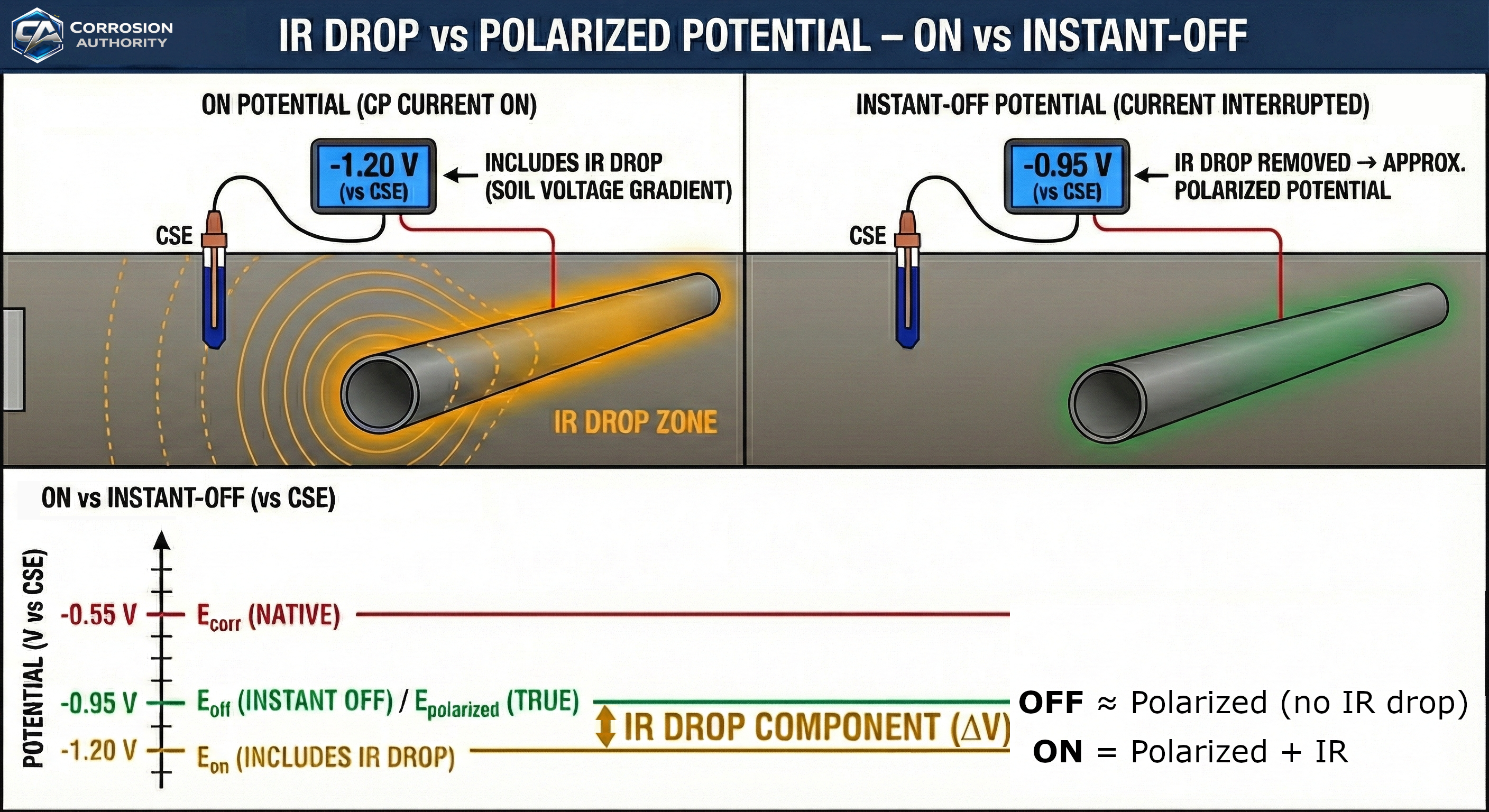
Shows how ON potentials include IR drop and how instant-OFF approximates polarized potential by removing IR drop (soil voltage gradient).
What this visual explains
This diagram distinguishes ON potential (includes IR drop from soil voltage gradients) from instant-OFF potential (removes most IR drop). The difference between ON and OFF is the IR component, not “extra polarization.”
Diagram
How to read it
- EON: structure-to-soil reading while CP current is applied (includes IR drop).
- EOFF: instant-off reading captured immediately after interruption (minimizes IR).
- IR drop: voltage component caused by current through soil resistance (ΔV between ON and OFF).
Field interpretation
Common mistakes
- Using ON values to claim compliance when IR drop is large.
- Capturing OFF too late (not “instant”), allowing depolarization to begin.
- Assuming OFF is “true potential” in every scenario (stray currents and dynamic conditions can still distort it).
CP 3 relevance
IR drop and instant-off interpretation are core CP 3 field concepts. Many troubleshooting questions depend on knowing what part of the voltage is polarization vs what part is IR.