
Anode System Life
What this calculation gives you
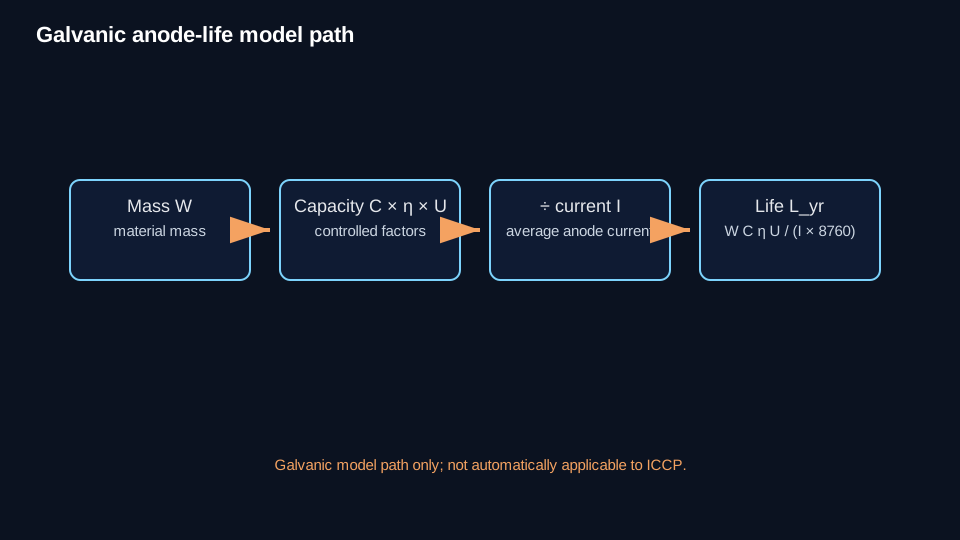
Estimate the calculated/design service life of an anode or anode system using the model appropriate to the anode type. Galvanic anodes use a capacity basis; impressed-current anodes use a consumption-rate basis. These paths are not interchangeable.
Governing equation(s)
Galvanic capacity form:
Lyr = (W × C × η × U) / (I × 8760)
Peabody material-specific imperial forms include LMg = (0.116 × Wlb × η × U) / IA and LZn = (0.0424 × Wlb × η × U) / IA. These constants remain tied to that material/model basis.
Impressed-current consumption-rate form:
L = Wu / (Iavg × Cr)
Where separately justified utilization applies: L = (W × U) / (Iavg × Cr). A source-explicit interference model is L = (Wt × U × E) / (Ia × Cr). Factor treatment must follow the controlled source/material data.
Variables
| Symbol | Meaning |
|---|---|
| L, Lyr | calculated/design life |
| W, Wt, Wu | anode mass / total mass / usable mass as defined by the selected model |
| C | galvanic electrochemical capacity, Ah per unit mass |
| η / E | current efficiency where applicable; omit when already embedded in effective capacity |
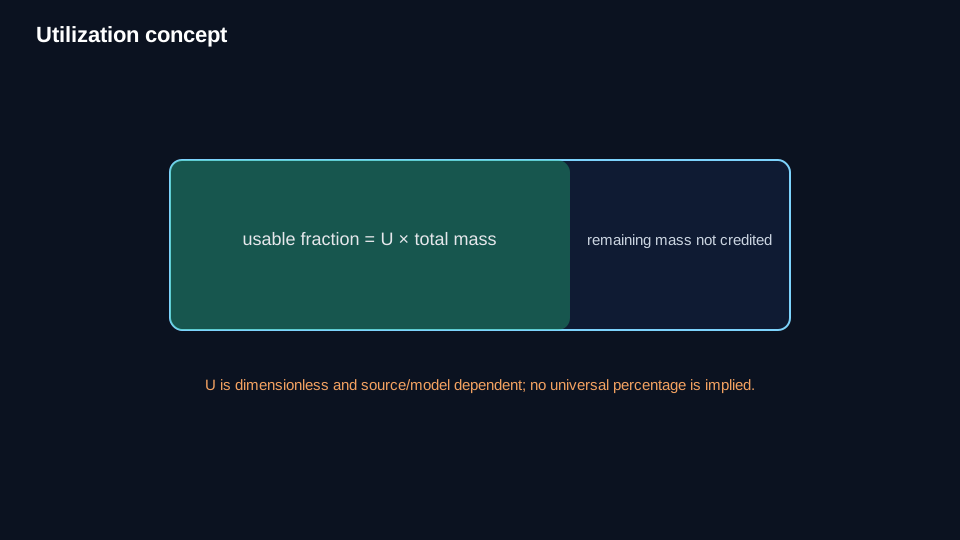
| U | source/design-specific utilization factor |
| I, Iavg, Ia | anode/system current used by the life model; state whether design, average, or measured basis |
| Cr | controlled material consumption rate |
Units
Use mass and capacity/consumption units from the same controlled basis. Galvanic capacity may use Ah/lb or Ah/kg; current is in amperes; the controlled general galvanic form uses 8760 h/yr. ICCP consumption rate must use mass/(A·time) units consistent with the desired time result. Do not mix lb- and kg-based data.
Conditions and assumptions
- The selected model matches the anode type.
- The current used represents the intended average/design basis; a spot measurement is not automatically a long-term average.
- Efficiency is included only when it is not already embedded in the selected capacity value.
- Utilization and efficiency are source/design inputs, not universal defaults.
- For parallel anodes, equal current sharing is an assumption unless demonstrated.
- Material-specific ICCP consumption data must come from a controlled applicable source; no default material constant is supplied here.
Worked calculation
Galvanic example — hypothetical design inputs: magnesium anode mass W = 50 lb; efficiency input η = 0.50; utilization input U = 0.85; assumed average/design current I = 0.10 A.
LMg = (0.116 × 50 × 0.50 × 0.85) / 0.10
0.116 × 50 = 5.8
5.8 × 0.50 × 0.85 = 2.465
2.465 ÷ 0.10 = 24.65
Result: LMg ≈ 24.7 years
The efficiency and utilization values are example inputs to be obtained from the applicable controlled design/source; they are not Corrosion Authority defaults. No numeric ICCP material example is promoted because the controlling handoff does not supply a universal public consumption constant.
Interpretation
The result is a calculated life under the stated mass, efficiency, utilization, material-model, and current assumptions. It is an engineering expectation, not a guaranteed replacement date and not a measurement of remaining life.
Limitations
Actual service life can change with current demand and sharing, environment, material, geometry, deterioration, installation condition, monitoring, maintenance, and operating history. Original design arithmetic alone cannot establish remaining life. Material-specific ICCP presets are not authorized without controlled data.
Common mistakes
- Applying a galvanic capacity equation to ICCP anodes.
- Applying an ICCP consumption rate to galvanic anodes.
- Double-counting current efficiency when capacity already includes it.
- Treating 0.85 utilization as universal.
- Automatically substituting total facility current, rectifier output, calculated Current Requirement, or measured shunt current without establishing that it is the required life-model current basis.
- Dividing system current equally among anodes without identifying that assumption.
- Treating calculated design life as measured remaining life.
Technical visuals
Next action
Verify the current basis and applicable material data before using the result for design. If remaining life is the question, obtain condition and current-history evidence. Use Shunt Current when a controlled shunt measurement is the appropriate current input; do not assume that measurement automatically represents long-term average current.