100 mV Polarization Criterion
Criterion quick answer
The 100 mV Polarization Criterion requires evidence of at least 100 mV of cathodic polarization within the applicable asset scope.
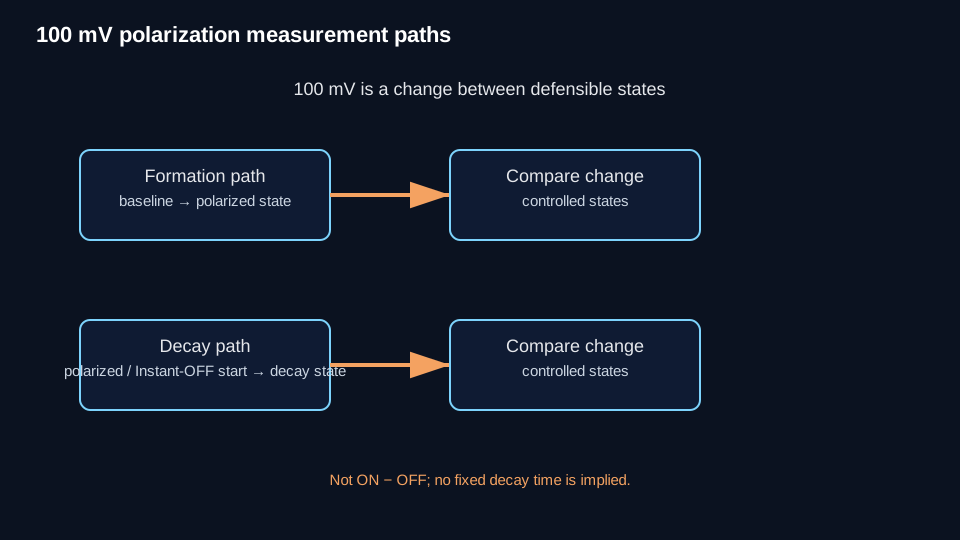
It is a change criterion, not an absolute-potential threshold. The required change may be demonstrated by polarization formation or polarization decay where the governing asset standard permits that path. An Instant-OFF value alone does not establish 100 mV polarization.
Applies to
The controlling transformed authority authorizes 100 mV cathodic-polarization criterion treatment for:
- steel and gray/ductile cast-iron piping within SP0169-2024 scope;
- steel UST structures within SP0285-2021 scope;
- on-grade carbon-steel tank bottoms within SP0193-2016 scope.
Asset-specific measurement provisions remain in force.
What is being evaluated?
The criterion evaluates a change in potential caused by cathodic polarization. It does not ask whether the structure is 100 mV more negative than −850 mV, 100 mV different between any two readings, or 100 mV different between ON and OFF by default.
Path 1 — Polarization formation
- Establish a defensible pre-polarization/free-corrosion comparison state.
- Apply or increase cathodic protection.
- Establish a defensible later polarized state.
- Demonstrate at least the required cathodic potential shift.
- Confirm valid measurement conditions.
An unstable or changing native/free-corrosion state can undermine the comparison.
Path 2 — Polarization decay
- Establish a defensible starting polarized state.
- Interrupt or remove protective current under controlled conditions.
- Measure potential as polarization decays.
- Demonstrate the required loss of cathodic polarization.
- Confirm valid measurement conditions.
A valid Instant-OFF measurement commonly provides the starting polarized-potential value. Complete return to the original free-corrosion potential is not inherently required once the required decay has been demonstrated where the governing method permits that conclusion.
Instant-OFF is not the criterion
Instant-OFF can establish the starting polarized potential for a decay measurement. A second defensible potential is required to show the amount of polarization change.
Instant-OFF value alone → not enough evidence.
Decision logic
- Applicability: establish that the asset is within an authorized 100 mV criterion scope.
- Measurement path: establish an authorized formation or decay approach.
- Comparison states: establish technically defensible starting and ending states for that path.
- Measurement foundation: control reference basis, placement, meter/circuit condition, current state, interruption, timing, and relevant interference conditions.
- Polarization change: only now determine whether the defensible comparison demonstrates at least 100 mV of cathodic polarization.
What does not establish compliance
ON − OFF = 100 mV.- Any arbitrary 100 mV difference.
- Instant-OFF being 100 mV more negative than −850 mV.
- A 100 mV shift measured from an unstable or undefined baseline.
- A decay value with an invalid starting Instant-OFF measurement.
- A comparison affected by uncontrolled current/interference without resolving validity.
Field cautions
- A stable baseline matters.
- An invalid Instant-OFF starting point invalidates a decay comparison even if the arithmetic exceeds 100 mV.
- Do not assume one universal interruption duration or decay interval.
- Depolarization is not synonymous with Instant-OFF.
- This criterion is not interchangeable with the −850 mV CP Criterion.
Next action
Use Polarization for the change/state terminology, Instant-OFF Potential to validate an interrupted starting value, IR Drop for voltage-drop effects, Reference Electrode and Reference-Electrode Placement for reference controls, Meter Loading for circuit-loading validity, and −850 mV CP Criterion when evaluating the separate absolute-potential route.
Technical visuals