−850 mV CP Criterion
Criterion quick answer
A reading near or more negative than −850 mV relative to CSE is not automatically a pass.
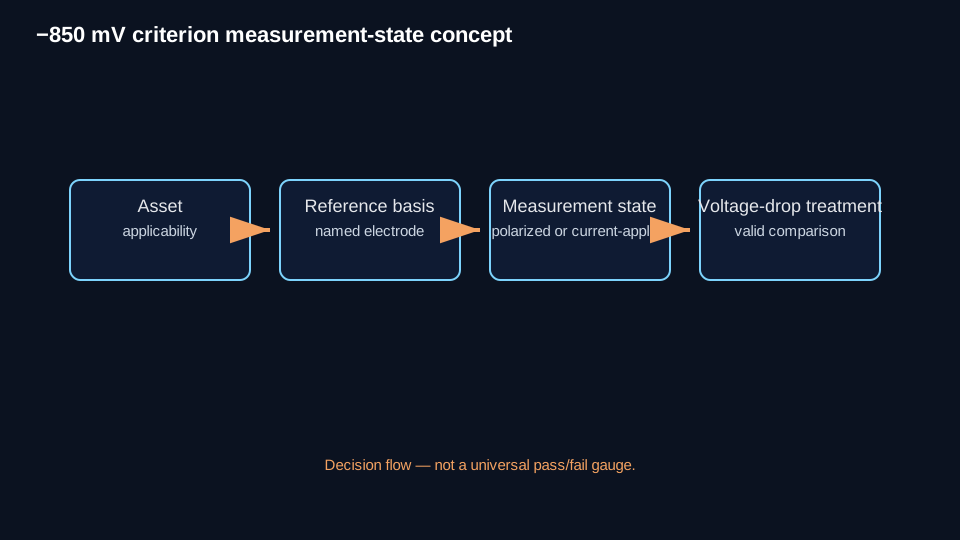
First establish the applicable asset criterion, correct reference basis, authorized measurement route, required voltage-drop treatment, and measurement validity. Only then make the numerical comparison required by the applicable criterion.
Applies to
The controlling transformed authority establishes −850 mV CSE criterion routes for:
- underground/submerged steel and gray/ductile cast-iron piping within SP0169-2024 scope;
- steel underground storage-tank structures within SP0285-2021 scope;
- on-grade carbon-steel tank bottoms within SP0193-2016 scope.
The similar number does not make the asset-specific requirements interchangeable.
Reference basis
The authorized −850 mV formulations use saturated CSE as the explicit reference basis. Do not compare a value on a different reference basis directly with −850 mV CSE unless the equivalent expression is defensibly controlled by applicable authority.
Measurement routes by asset
| Asset scope | Authorized route summarized by C2 |
|---|---|
| Pipeline — SP0169-2024 | −850 mV or more negative relative to saturated CSE using a direct polarized-potential measurement, or a current-applied potential with required consideration of voltage drops in earth and metallic paths. |
| UST — SP0285-2021 | −850 mV CSE with CP applied and voltage-drop consideration, or −850 mV CSE polarized potential. For specified impressed-current and field-installed galvanic-anode UST systems, Instant-OFF is identified as the primary method for considering voltage drops, while other engineering methods are allowed. |
| On-grade carbon-steel tank bottom — SP0193-2016 | −850 mV CSE with CP current applied and voltage-drop consideration, or −850 mV CSE polarized potential. Measurement geometry and reference placement remain asset-specific. |
What a defensible criterion decision requires
- Applicability: establish the governing asset scope and that this criterion route applies.
- Reference basis: establish the required CSE basis or a defensibly controlled equivalent.
- Measurement route: establish a defensible polarized potential or an allowed current-applied potential.
- Voltage-drop treatment: for a current-applied route, consider significant voltage drops as required.
- Measurement validity: establish adequate reference condition, placement, current state, timing, residual-current, meter/circuit, and other relevant controls.
- Numerical comparison: only now apply the exact comparison for the applicable asset authority.
What does not establish compliance
- “The meter reads −850 mV.”
- “The ON reading is −900 mV CSE.”
- “The rectifier was turned off.”
- “The OFF reading is more negative than −850 mV.”
- “The structure met −850 mV last year.”
- “The 100 mV criterion also looks close.”
Field cautions
- A more negative number can still be a poor criterion measurement if the state or voltage-drop treatment is wrong.
- A questionable Instant-OFF value is not rescued by being numerically beyond −850 mV.
- Instant-OFF does not automatically remove all IR drop.
- Meeting an applicable CP criterion does not establish that interference is acceptable.
- This criterion is not interchangeable with the 100 mV Polarization Criterion.
Next action
Use Structure-to-Electrolyte Potential for measurement meaning, Reference Electrode and Reference-Electrode Placement for reference controls, Meter Loading for circuit-loading validity, Instant-OFF Potential for interrupted-value interpretation, IR Drop for voltage-drop effects, and 100 mV Polarization Criterion when evaluating demonstrated polarization change instead of this absolute-potential route.
Technical visuals